The Liberal Party was founded in 1880s to oppose Bernardino Caballero and the Colorado Party. The party won the presidency in 1904 and lost support thanks to the Chaco War. After that the Liberal Party never recovered and under Stroessner, it became illegal. It was mostly ineffective and inept in challenging the Colorado Party after and during the Stroessner regime. Many members of the Liberal Party were imprisoned, tortured, killed or exiled from the country during the Stroessner dictatorship.
Out of the ashes of the Liberal Party rose what is currently Paraguay’s biggest opposition party, the Partido Liberal Radical Auténtico (PLRA). The PLRA finally won back power in 2008 thourgh its alliance with Fernando Lugo and other parties in the presidential election.
The PLRA is currently the second largest and popular political party in Paraguay. The current vicepresident, Federico Franco, belongs to the party.
During the Stroessner dictatorship, thousands of Paraguayans went to Argentina. Also, thousands of Paraguayans went to the United States and there is a huge community in New YorkCity. In 1979 around 11,000 Paraguayans came to the United States. Alost of these came for political reasons (Stroessner) but many were young people in search of job or study opportunities. There is also a large Paraguayan community in Brazil.
In recent times, nothing is changing for the normal or poor people of Paraugay. The president before Lugo was a Colorado named Nicanor Duarte. During his presidency (2003-08) there was a little bit of growth that reached 6.8% in 2007 but this was largely due to soybean agriculture and exportation expansion and meat production, (Nickson, 2008).
When it seems that it is a time of small growth or optimism, there are mass migrations from Paraguay. The value of exports has gone from US$1 billion in 2005 to US$3 billion in 2007. Because people in the country, especially young people and rural people in 2002 the mass migration started. There were around 100,000 Paraguayans living in Spain in 2007 with only 11,000 being there legally.
Soy has become the biggest cultivated crop in Paraguay. The soy boom started in the 1980s when Stroessner was still in power.
Before the soy boom, Paraguayan farmers grew a variety of crops and raised livestock for self sustenance and also to sell. They did not make much money but were in most cases at least able to feed themselves (usually not in an adequate manner). This is especially in the eastern region of the country were most of the population lives. This practice also kept the biodiversity of the region from being wiped out because farmers used fruit trees that were native to the region.
Today, roughly about five percent of the eastern forests remains and what can be seen is a sea of short green plants. These are the soybean plants. Industrial farmers, with many coming from Brazil, have been buying up the land for very cheap prices. In many cases farmers have been bullied, threatened or violence has been used against them. Many times these farmers are in debt and have to grow soy for loans. Also, the soy boom has not only evicted thousands of farmers, it has also displaced many indigenous communities.
Because the farming of soy is highly mechanized, many of those farmers who stayed behind to work have lost their jobs.
Soy has made the overall revenue of the country increase. There is a very large demand for soy worldwide and Paraguay has become a top worldwide producer. This growth in Paraguay reached 6.8% in 2007. But, because of the level of corruption in Paraguay, soy farmer do not observe the laws. For example they may use dangerous pesticides that can go into nearby communities.
But, the National Statistical Office reports that 35.6% of the 6.2 million Paraguayans were still living in povert in 2007 and Paraguayans living in extreme poverty has increased from 15.5% in 2005 to 19.4% in 2007.
Before, farmers were able to eat what they grew. But now with the soybean boom, they can no longer do that and they cannot grow livestock. Instead now they have to buy for most of their necessities.
Even though many of their leaders have beenassassinated, Paraguayan farmers have become more organized. With the election of Fernando Lugo as president, there is hope among farmers because Lugo stated he would try to start a land reform. This will be very hard because so much of the land is privately owned and also because the corrupt Colorado Party machine is still intact. In Paraguay roughly one percent of the population owns 80 percent of the land.
Fernando Lugo is a former Roman Catholic bishop who became the first non-colorado president of Paraguay in more than 60 years. The colorados had been ruling the country (and very badly) since 1947. Lugo lead a coallition of opposition political parties called the Patriotic Alliance for Change. He was alliade with the Liberal Party which is the second biggest party in Paraguay. This gave him a big push in his victory over the colorados. The 57 year old Lugo assumed office August 15, 2008 and his running mate and vice president is Federico Franco (who belongs to the Libertal Party).
Lugo was born in 1951 and became a priest in 1977. He was a missionary in Ecuador for five years. In 1992 Lugo was appointed head of the Divine Word order of Paraguay and two years later he was made a bishop. Lugo went on the serve ten years in the poor region of San Pedro, were he came to be known as the "bishop of the poor." Lugo has been highly influenced by the "liberation theology."
Lugo started gaining more national and even international attention when he helped organize and lead a big opposition rally in March 2006. Since the Paraguayan constitution prohibits ministers of any faith in becoming political candidates, Lugo resigned from the Catholic Church in December of 2006. The Vatican at first was undecided as to accepting his resignition or not and suspended him from his duties instead. In July, 2008 the Pope Benedict XVI decided to grant Lugo's request and remove his clerical status.
Lugo won with 41 percent of the vote while Blanca Ovelar, the Colorado Party candidate, recieved 31 percent of the vote. Lugo is preaching land reform and also renogotiaions of the treaties for both the Itaipu and Yacyreta dams (which Stroessner and previous colorado governments handled disastreoulsy).
The election of Lugo was an event of great joy for most paraguayans. Even many colorados voted for him because they were sick of all the corruption and poverty that the Colorado Party brought to the country. Sadly the Colorado Party is making things almost impossible for President Lugo. Every initiative and proposale is rejected and fought by the colorados. There are even splits in his own movement and this especially comes from the Liberal Party. Even his vice president has been making unfavorable comments on Lugo. Hopefully for those of us that want an equal and prosperous Paraguay, Lugo will be able to pull ahead with his plans.
The ministers of foreign affairs of both Paraguay and Brazil signed the “Act of Iguaçu” in 1966, which began the studies of the hydroelectric potential of the Parana River. Construction started in 1975 and the last remaining expansions ended in 1991. The Itaipu Dam has 20 generators that produce 14,000 MW (megawatts). Around four million people resettled due the the construction of the dam and the construction of the dam also produced much environmental turmoil for the area.
The Itaipu dam is 7,919 meters long and has a maximum height of 196 meters. During the construction of the dam, approximately 50 million tons of rock and earth to dig a 1.3 mile bypass. This bypass shifted the course of the Parana River.
The Itaipu dam and surrounding area is a major tourist attraction. Since its completion in 1991, more than nine millions tourists have visited the dam.
The Itaipu dam negotiations and treated were enacted during the dictatorship of Alfredo Stroessner in Paraguay. The dam produces about 90 percent of the energy that Paraguay needs and 20 percent of the energy Brazil needs. For this reason only one generator is usually used for Paraguay. The enery that the rest of the nine generators (the Paraguayan half) produce, is sold to Brazil.
Thanks to these negotiations by Stroessner, the Brazilians receive a very generous, and unfair (for the Paraguayans) price for the surplus energy. In Paraguay, electricity is redicuosly expensive for such a poor country with two dams (the other being the Yacyreta dam). I speak this with personal experience since I lived there. Thanks to the corruption of the Stroessner dictatorship, and colorado governments that came after, we pay alot for electricity when it should be next to free.
The Colorado Party was funded in 1887 by Bernardino Caballero and has its headquarters in Asuncion (the capital). The Colorado Party has been in power from 1876 to 1904 and from 1948 to 2008. From 1947 to 1962 all other political parties were considered illegal.
The Colorado Party (Asociacion Nacional Republicana or National Republican Association) are right wing conservatives. They are called colorados because of their red flag. The party has always been characterized by corruption, violence and the traffic of favors.
Until recently it was required to be a member of the Colorado Party if you wanted free medical care, job security or promotions and other services. The Colorado Party controlled (and in many cases still does) the whole public sector of the Paraguayan government (national and local). Through this Paraguay has always been characterized as one of the most (if not the most) corrupt country in the world. The Colorado Party also served as one of support systems for the bloody dictatorship of Alfredo Stroessner (the other being the military).
During election times after the dictatorship the Colorado Party has always resorted to fraud and violence to obtain victory. But, because the Colorado Party controls the public government system it is the greater employer. That is why it always has alot of popular support. Thankfully for those of us that want a more equal Paraguay, the Colorado Party was defeated on election day (April 20, 2008) by Fernando Lugo. Lugo lead a coallition of opposing political parties.
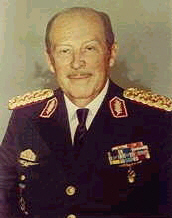
Alfredo Stroessner was one the longest running dictators the world had ever seen.He ruled Paraguay with an iron fist from 1954 to 1989.Born on November 3, 1912, Stroessner joined the army at 17 years of age.He was named commander and chief of the armed forces in 1951 and led the coup that overthrew President Federico Chavez in 1954.Stroessner became president that same year.
Stroessner belonged to the Colorado Party that had been ruling since 1948 (and would continue to rule until 2006).
Stroessner himself was overthrown in 1989 Gen. Andres Rodriguez who had most of the country’s popular support at that time.Exiled in Brazil, Stroessner died in 2006 a very rich man.
During his regime, thousands of people were tortured and murdered.These people usually belonged to opposition parties or were socialists.One method of murder used was throwing people off planes.
Abundance and riches for those around him (usually army generals) also characterized Stroessner’s reign.The rest of the country lived in poverty.
I am currently a senior in George Mason University and I am going for a communication B.A. I was born and raised in Asuncion, Paraguay and moved to United States when I was five years old. In the U.S. I have always lived in the Northern Virginia area. Writing is one of the best tools that I have and that is why I decided to be a Communications Major.